
What a Court Docket Shows in Ingham County
In Ingham County, a court docket is a list. Each line, called an entry, marks one event in a case. The docket records the date, a short label for what happened, and often the party or judge tied to that step. Taken together, the entries form a timeline that runs from the first filing to the final order. A reader can scan an Ingham County docket and see how a case has progressed without opening a single full document.
A docket is not the full case file. The full file holds the actual papers: the complaint, motions, exhibits, written orders, and transcripts. The docket only points to those papers and dates them. Think of the docket as the table of contents and the file as the book itself. For many everyday questions, such as when a hearing is set or whether a case has closed, the docket alone answers them. Deeper legal review needs the full file. That file comes from the court clerk.
Ingham County docket data comes from more than one court. The Circuit Court, the Probate Court, and three district courts each keep their own dockets. That split shapes where and how a case shows up online.
Ingham County Courts That Publish Dockets
Michigan uses a layered court system, and Ingham County reflects it. The Circuit Court is the primary trial court for felonies, larger civil suits, and family matters. The Probate Court handles estates, guardianships, and conservatorships. Below them sit the Ingham County district courts, which take misdemeanors, traffic cases, small claims, and landlord-tenant disputes. Appeals travel from these Ingham County trial courts to the Michigan Court of Appeals and then, in select cases, to the Michigan Supreme Court.
Three district courts divide Ingham County by geography. Knowing which Ingham County court holds a case is the first step in any docket search.
- 55th District Court covers Ingham County outside the cities of Lansing and East Lansing.
- 54-A District Court covers the City of Lansing.
- 54-B District Court covers the City of East Lansing.
Circuit and Probate dockets flow through the county court portal. District court dockets are published mainly through the statewide Michigan case-search system. A single case may leave a trail in more than one place if it started in a district court and moved up to the Circuit Court. Venue in Ingham County follows the city where the case began.
Note: A criminal matter can begin with a district court arraignment and later appear on the Circuit Court docket once it is bound over for felony proceedings.
Reading the Ingham County Hearing Docket
The fastest public view of upcoming activity is the Ingham County Court Hearing Schedule. This tool lists scheduled hearings by date and courtroom, so a visitor can confirm when and where a case is set to be heard. It works well for anyone who needs the next court date without pulling a full case history. The Ingham County schedule shows the essentials of each hearing row. It updates as the court calendar changes.
Each row on the hearing schedule carries a handful of fields. The layout below shows what a single docketed hearing typically displays.
| Field | What It Shows |
|---|---|
| Date | The calendar day the hearing is set to take place |
| Time | The scheduled start time for the case call |
| Courtroom | The room or judge assigned to hear the matter |
| Case Title | The party names, such as People v. Doe or Smith v. Jones |
| Case Number | The court-assigned file number that identifies the case |
| Status | The hearing type or stage, such as arraignment, motion, or pretrial |
The hearing schedule is a snapshot, not a complete history. It shows what is coming up, not every event that has already passed. For the full run of entries on a case, the record search tools give a deeper view.
Searching Circuit and Probate Case Dockets
For case history in the two upper courts, Ingham County runs the CourtRecordSearch portal. It searches Ingham County Circuit and Probate records in one place and needs no account. A user picks the court to search, then enters a name, a business name, or works through the search-by-case-number path. Party type and case type filters help narrow a common name.
Coverage has limits worth knowing before a search. Criminal cases reach back to 2000, while other Circuit and Probate cases go back to 1986. Older matters may not appear online at all and sit only in the clerk's files. The portal also notes that the official record stays on file at the Clerk's Office even when the screen shows only a summary. A few practical habits improve results in Ingham County.
- Open the CourtRecordSearch portal and choose Circuit or Probate.
- Enter a last name plus a date of birth to narrow active and older cases.
- Use party type and case type filters for common names.
- Switch to the case-number path when the file number is known.
- Review the result row, then request the full file from the clerk if needed.
These dockets sit at the trial-court level, so they connect to the broader body of Ingham County court records and to the case files kept by the Circuit Court.
District Court Dockets Across Ingham County
District court dockets are searched through Michigan's statewide case-search platform rather than the county portal. Each of the three courts has its own entry point on that system. The 55th District Court, based in Mason, publishes its dockets at the state 55th District case search page.
The lead-in image below links to that 55th District docket search, the tool most Ingham County residents outside the two cities will use for misdemeanor and traffic cases.
Residents of Lansing look to a different court. The 54-A District case search covers cases filed within the city limits, including local traffic and ordinance matters.
East Lansing has its own venue as well. The 54-B District case search reaches cases from that city, and the 54-B court also runs separate civil, criminal, traffic, and treatment-court tracks.
Because venue follows geography, an Ingham County search that comes up empty in one district court often just means the case belongs to another. Checking the city where the offense or filing occurred saves time.
Note: District court dockets and the county Circuit portal are separate systems, so a full picture of a case sometimes calls for a look in both places.
Docket Versus the Full Case Record
The difference between a docket and a full case record shapes what an Ingham County search can and cannot deliver. A docket is a list of dated events. A full record holds the documents behind those events. One is fast and free to scan online; the other may take a clerk request, a copy fee, or an Ingham County courthouse visit.
| Docket | Full Case Record | |
|---|---|---|
| Format | List of dated entries | Filed documents and orders |
| Access | Often online and free | May need a request, fee, or visit |
| Use | Track dates and status | Legal review and evidence |
| Detail | Summary of each event | Full text of each filing |
For a hearing date or a case status, the docket is enough. For a signed order, a motion's text, or a transcript, the full file is the goal, and that comes from the Ingham County clerk who keeps the official record.
Criminal Versus Civil Dockets in Ingham County
In Ingham County, criminal and civil dockets track different journeys, and the labels on each reflect that. A criminal docket follows the state's case against a person. Its entries include arraignment, bond decisions, pretrial conferences, pleas, trial dates, and sentencing. A civil docket follows a dispute between parties, such as a contract claim, a family matter, or a landlord-tenant case. Its entries lean on complaints, answers, motions, and judgments.
Party labels shift between the two as well. In a criminal case the state is the moving side. The accused is the defendant. In a civil case the person who files is the plaintiff or petitioner, and the other side is the defendant or respondent. Ingham County's search tools let a user filter by these party and case types. That speeds up a targeted docket search.
Privacy rules also treat the two tracks differently, and some entries never reach the public view. Personal protection orders, or PPOs, carry restrictions, and the Ingham County portal notes that PPO information is not available online. Juvenile matters are shielded by Michigan law under the juvenile confidentiality statute. Sealed and expunged records drop out of public dockets by court order. When a docket looks thin or a case seems missing, a privacy rule may be the reason rather than a data gap.
Note: If a docket shows no result for a name you expect to find, the case may be juvenile, sealed, or restricted rather than simply absent from the system.
Offline Access to Ingham County Court Dockets
Not every docket lives online, and the oldest cases rarely do. When a search returns nothing, the Ingham County Clerk's Office is the next stop. Ingham County circuit and district clerks keep the official files and can pull records that predate the online coverage windows. Requests run through in-person visits, phone calls, mail, and written records requests, with copy and certified-copy fees set by the court copy fee schedule. Calling ahead is wise, since filing windows and counters vary by building and division.
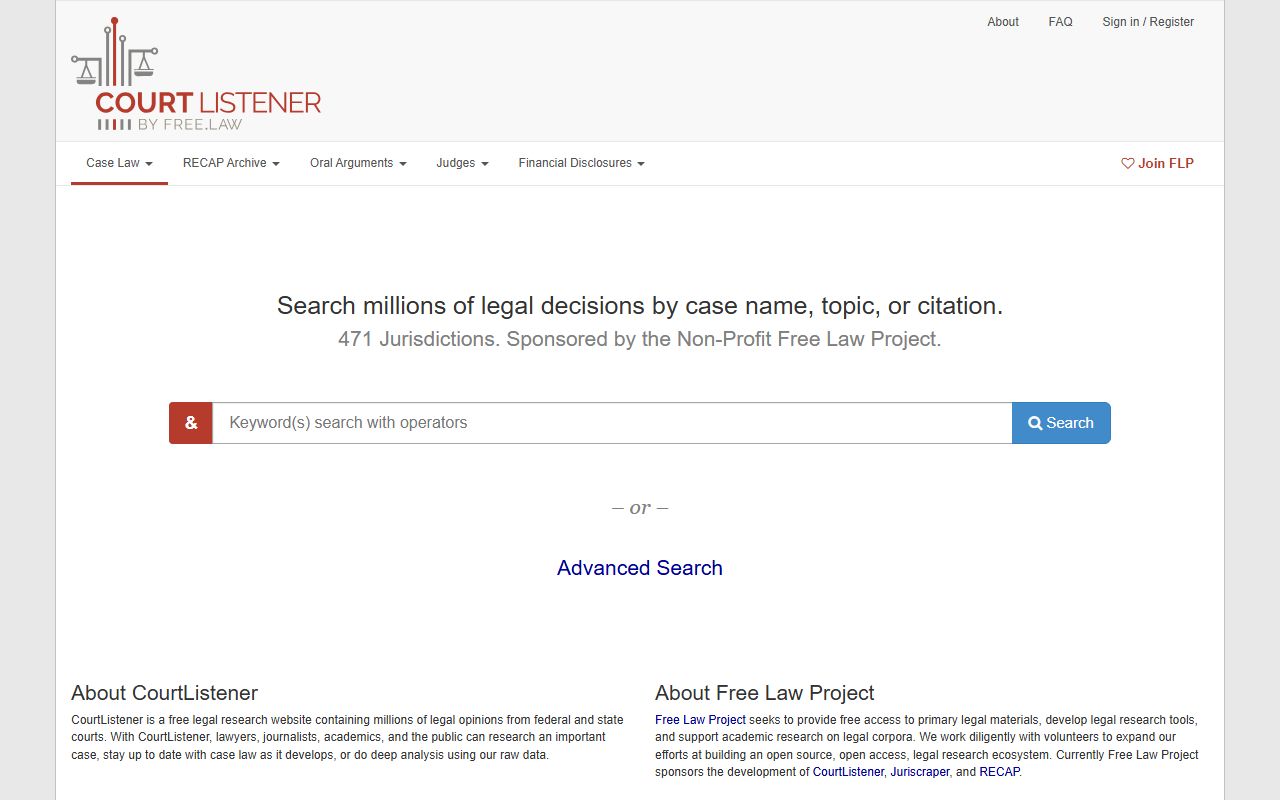
Federal cases follow a separate track entirely. Matters heard in the U.S. District Court for the Western District of Michigan, which sits in Lansing, do not appear in county or state dockets. Those dockets are indexed on public archives such as CourtListener, a nonprofit docket resource that offers a free window into federal filings.
The image below links to the CourtListener archive, a useful fallback when a case is federal rather than county-level.
Putting the channels together, a strong docket strategy in Ingham County moves from the right court to the right tool. Start with the hearing schedule for dates. Use CourtRecordSearch for Circuit and Probate history. Pivot to the state platform for district cases. Fall back to the clerk for older or restricted files. That order matches how the county's split court system actually stores its records.